

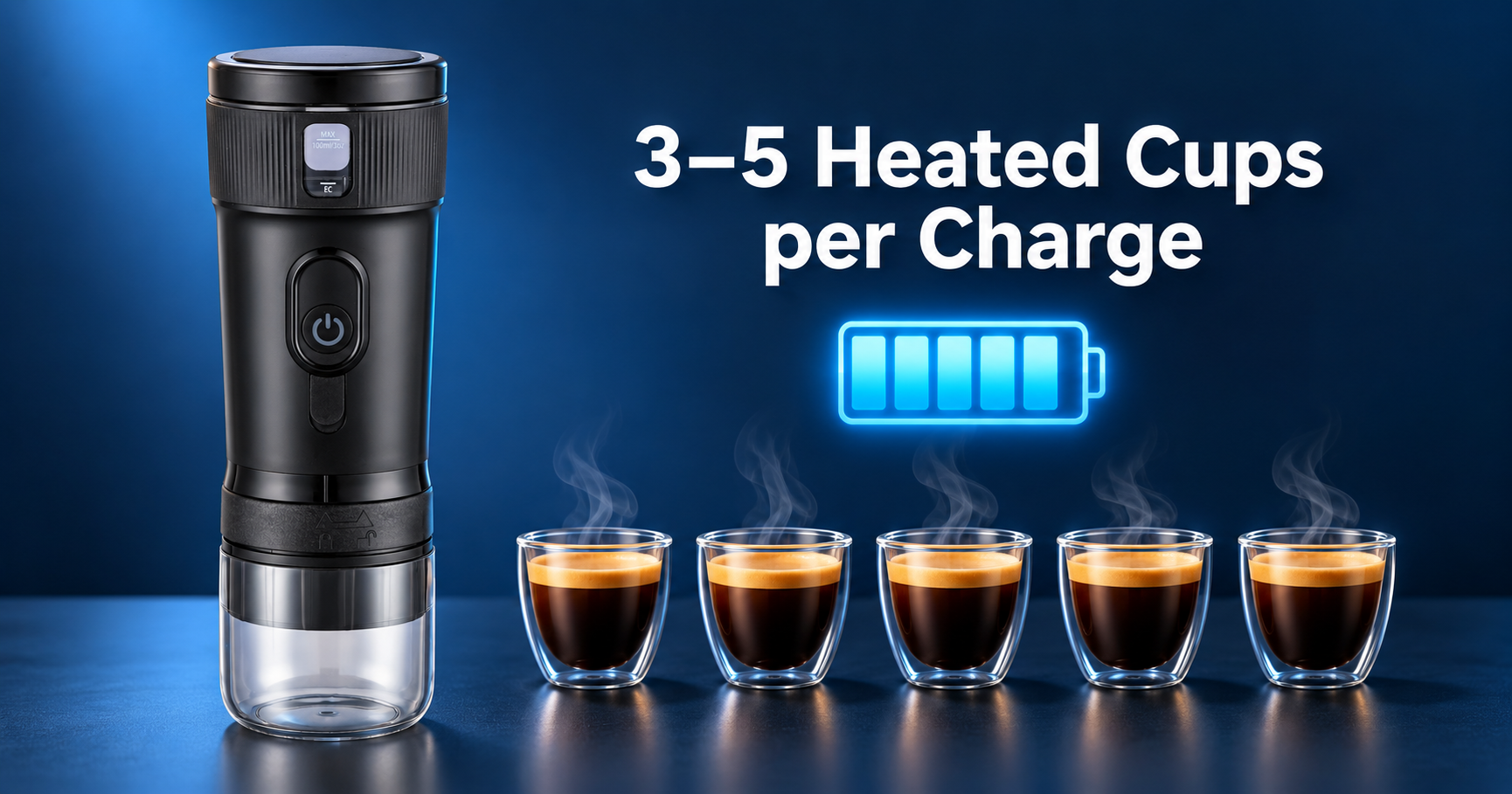
The CM1001B-PLUS normally makes approximately 3–5 cups of coffee per full charge when it heats room-temperature water before extraction.
When preheated water is added and the internal heating function is not used, the machine consumes much less energy and can complete approximately 300–500 pump-only extraction cycles per charge under suitable operating conditions.
This large difference is normal. Heating water requires considerably more battery energy than operating the water pump.
The actual CM1001B-PLUS battery life depends on water volume, starting water temperature, ambient temperature, battery condition and brewing method.
Quick Answer: 3–5 Heated Cups per Charge
The CM1001B-PLUS portable coffee maker has a 10.8V, 2,600mAh rechargeable lithium-ion battery with a total energy capacity of 28.08Wh.
Its typical battery performance is:
| Operating mode | Approximate performance per full charge |
|---|---|
| Room-temperature water with internal heating | 3–5 cups |
| Preheated water without internal heating | Approximately 300–500 pump-only extraction cycles |
| Larger water volume | Fewer heated cups |
| Colder starting water | Fewer heated cups |
| Smaller water volume | Potentially more heated cups |
The 3–5 cup figure is a normal reference range, not a guarantee under every possible operating condition.
A user heating approximately 50ml of room-temperature water indoors may obtain a different result from someone heating 100ml of cold water outdoors.
CM1001B-PLUS Battery and Heating Specifications
The main specifications affecting battery life are:
| Specification | CM1001B-PLUS |
|---|---|
| Battery voltage | 10.8V |
| Battery capacity | 2,600mAh |
| Total battery energy | 28.08Wh |
| Heating module | 12V / 100W |
| Water pump | 12V / 5W |
| Rated pump pressure | Up to 20 bar |
| Water tank capacity | 100ml |
| Charging input | USB-C, 5V / 2A |
| Typical heated cups | Approximately 3–5 cups |
| Hot-water pump-only operation | Approximately 300–500 cycles |
The machine supports:
- Nespresso® Original-style capsules;
- Dolce Gusto®-style capsules;
- Ground coffee.
The selected coffee format can affect water-flow resistance and extraction time, but water heating remains the main source of battery consumption.
Why Heating Water Uses Most of the Battery
The CM1001B-PLUS contains two main electrical loads during coffee preparation:
- A 100W heating module;
- A 5W water pump.
The pump normally operates only during the short extraction cycle. The heating module must operate for several minutes to raise the water to the target temperature.
As a result, most of the battery energy is used before coffee extraction begins.
This explains why the machine may prepare only 3–5 cups when heating water but complete hundreds of pump-only cycles when preheated water is used.
The two figures describe different operating conditions and should not be compared as if they were the same type of test.
How Long Does It Take to Heat the Water?
Under normal indoor conditions, the machine takes approximately five to six minutes to heat about 50ml of room-temperature water to around 85°C.
Depending on the test conditions, the complete heating process may take approximately five to eight minutes.
Heating time is affected by:
- Water volume;
- Starting water temperature;
- Ambient temperature;
- Battery charge level;
- Battery condition;
- Heat loss during operation.
The 100ml specification describes the maximum capacity of the water tank. It does not mean that every cup must use the full 100ml.
Many consumers use approximately 40–60ml for an espresso-style serving. A larger beverage requires more water and therefore more battery energy.
How Water Volume Affects CM1001B-PLUS Battery Life
Water volume is one of the most important factors affecting the number of cups per charge.
Heating 100ml of water requires approximately twice the theoretical thermal energy needed to heat 50ml through the same temperature increase.
In actual operation, additional energy is also lost through:
- The water tank;
- Heating components;
- Internal tubing;
- Surrounding materials;
- The control circuit.
The practical result is straightforward:
- Smaller servings generally allow more heating cycles;
- Larger servings generally reduce the number of cups;
- Filling the full 100ml tank for every cycle uses more battery energy;
- Adding preheated water significantly reduces battery consumption.
For this reason, buyers should not compare portable coffee makers based only on the phrase “cups per charge.”
They should also compare:
- Water volume per cup;
- Starting water temperature;
- Target temperature;
- Ambient temperature;
- Battery energy in watt-hours;
- Whether the machine heats the water;
- Whether the published result includes extraction.
Without these conditions, two battery-life claims may not describe comparable performance.
How Starting Water Temperature Changes the Result
Colder water requires more energy to reach the same target temperature.
Heating 50ml of water from 10°C to approximately 85°C requires more energy than heating the same volume from 25°C.
CM1001B-PLUS battery performance may therefore vary between:
- Indoor use;
- Air-conditioned offices;
- Summer travel;
- Winter camping;
- Refrigerated water;
- Room-temperature bottled water.
A camping brand targeting cold-weather users may obtain different results from an office-accessory brand testing the same machine indoors.
OEM buyers should test the product under conditions that represent their intended customers and market.
Cold-Water Heating Mode
Cold-water heating mode is intended for users who do not have access to a kettle or another source of hot water.
In this mode, the machine:
- Heats the water;
- Monitors the target temperature;
- Activates the pump;
- Extracts the coffee.
Advantages
- No separate hot-water source is required;
- Suitable for cars, camping and outdoor use;
- Provides a complete portable coffee-making process;
- More convenient when travelling.
Limitations
- Longer preparation time;
- Higher battery consumption;
- Approximately 3–5 cups per charge;
- Performance varies with water temperature and volume.
This mode demonstrates the main advantage of a self-heating portable coffee maker, but it also places the highest load on the battery.
Hot-Water Extraction Mode
If hot water is already available, the user can add it to the water tank and start a pump-only extraction without activating the internal heater.
Because the 5W pump requires much less energy than the 100W heating module, the machine can complete approximately 300–500 pump-only extraction cycles per charge under appropriate operating conditions.
Hot-water mode is suitable for:
- Homes;
- Offices;
- Hotels;
- Campsites with a kettle;
- Service stations;
- Vehicles with a separate water heater.
Advantages
- Faster coffee preparation;
- Much lower battery consumption;
- Far more extraction cycles per charge;
- Less waiting before brewing.
Limitation
- A separate source of hot water is required.
The 300–500 figure refers to pump-only operation. It does not mean the machine can heat water hundreds of times from one charge.
Does the Coffee Format Affect Battery Life?
The CM1001B-PLUS is a three-in-one machine compatible with Nespresso® Original-style capsules, Dolce Gusto®-style capsules and ground coffee.
Each coffee format creates a different level of resistance inside the extraction system.
Battery consumption may be affected slightly by:
- Capsule structure;
- Coffee grind size;
- Coffee quantity;
- Coffee compaction;
- Water-flow resistance;
- Pump operating time;
- Beverage volume.
However, these differences are normally much smaller than the energy used for heating.
The main factors affecting portable coffee maker battery life remain:
- Whether the heater is activated;
- Water volume;
- Starting water temperature;
- Target temperature;
- Battery condition.
Why Battery Capacity Should Be Compared in Wh
Portable coffee maker listings often describe battery size only in milliamp-hours.
However, mAh alone is not sufficient when comparing batteries that operate at different voltages.
The CM1001B-PLUS battery is rated at:
- 10.8V;
- 2,600mAh;
- 28.08Wh.
Watt-hours account for both battery voltage and capacity and provide a clearer indication of total stored energy.
For example, a 2,600mAh battery operating at 10.8V stores considerably more energy than a 2,600mAh battery operating at 3.7V.
When comparing rechargeable portable coffee makers, buyers should review:
- Battery voltage;
- Battery capacity in mAh;
- Total battery energy in Wh;
- Heating power;
- Water volume;
- Heating time;
- Cups per charge;
- Test conditions.
A larger mAh number alone does not automatically mean better heating performance or longer runtime.
Why We Use a 3–5 Cup Range
A fixed claim such as “exactly five cups per charge” would not accurately represent every operating condition.
Battery performance varies according to:
- Water volume;
- Initial water temperature;
- Ambient temperature;
- Battery charge level;
- Battery age;
- Heating time;
- Extraction time;
- Time between brewing cycles.
For OEM packaging, online listings and user manuals, we recommend wording such as:
Approximately 3–5 cups per full charge when heating room-temperature water, depending on water volume, starting temperature and operating conditions.
This is more accurate than publishing an absolute figure without describing the test conditions.
How to Get More Cups per Charge
Users can improve practical battery performance by following several simple steps.
Use Only the Water Required
Heating unused water consumes battery energy without improving the coffee.
Avoid Refrigerated Water
Room-temperature water requires less energy than very cold water.
Begin With a Fully Charged Battery
A full charge provides the most consistent heating performance.
Use Preheated Water When Available
Hot-water mode preserves battery capacity and reduces preparation time.
Avoid Repeated Reheating
Restarting the heating process unnecessarily wastes energy.
Store the Machine at a Moderate Temperature
Lithium-ion battery performance may decrease in very cold environments.
Keep the Heating System Clean
Mineral deposits can affect heat transfer. Regular cleaning and suitable water help maintain consistent heating performance.
What OEM Buyers Should Test
Before confirming a private-label or wholesale order, buyers should evaluate battery life using conditions that represent their target market.
A useful sample test should record:
- Sample serial number;
- Initial battery status;
- Ambient temperature;
- Starting water temperature;
- Water volume;
- Capsule or ground coffee type;
- Heating time;
- Extraction time;
- Final beverage temperature;
- Number of completed cups;
- Remaining battery indication.
Where possible, buyers should test more than one sample.
A single unit can demonstrate how the product operates, but several samples provide a better indication of product consistency.
Any battery-life claim used on packaging, manuals or online listings should be based on clearly defined test conditions.
Battery Life and OEM Customization
The standard CM1001B-PLUS configuration uses a 10.8V, 2,600mAh battery pack.
Changes to the battery, heater or electronic system require engineering evaluation because they may affect:
- Product dimensions;
- Product weight;
- Heating time;
- Charging time;
- Electrical safety;
- Temperature protection;
- Battery management;
- UN38.3 testing;
- MSDS documentation;
- Shipping requirements;
- Production cost.
A larger battery is not a simple cosmetic upgrade. It may require changes to the housing, control board, wiring, battery protection and compliance documentation.
For many projects, improving test conditions and user instructions is more practical than changing the complete battery system.
What This Means for B2B Buyers
The CM1001B-PLUS is designed to balance:
- Portable size;
- Battery capacity;
- Heating performance;
- Coffee compatibility;
- Product weight;
- Manufacturing cost.
Its 3–5 heated-cup range is suitable for individual travel, commuting, camping and office use.
Brands requiring a larger number of heated servings should consider whether their target customer would accept:
- A larger and heavier battery;
- Longer charging time;
- Higher product cost;
- A larger product housing.
Battery life should therefore be evaluated together with size, weight, heating speed and target retail price.
Frequently Asked Questions
How many cups can the CM1001B-PLUS make per charge?
It normally prepares approximately 3–5 cups per full charge when heating room-temperature water before extraction.
Actual results depend on water volume, initial water temperature, ambient temperature and battery condition.
Can it make five cups using 100ml of water each time?
The 3–5 cup reference should not be interpreted as a guarantee of five full 100ml heating cycles.
Using the maximum tank capacity for every cycle requires more energy and may reduce the number of cups.
How long does it take to heat 50ml of water?
Under normal indoor conditions, approximately 50ml of room-temperature water can be heated to around 85°C in about five to six minutes.
Why can it complete 300–500 extractions with hot water?
When hot water is added, the 100W heater remains off and the battery mainly powers the 5W pump and control system.
This requires much less energy than heating water.
Does a 20-bar pump use a lot of battery power?
The pump consumes some energy, but the heating module is the main source of battery consumption.
The 20-bar figure describes the rated pump pressure, not its electrical power consumption.
Does Dolce Gusto-style extraction use more energy?
Different capsules may change water-flow resistance and pump operating time. However, water volume and heating have a much greater effect on total battery life.
Does the battery lose capacity over time?
Like other rechargeable lithium-ion batteries, available capacity may gradually decrease because of repeated charging, age, operating temperature and storage conditions.
Can the CM1001B-PLUS battery be customized?
Battery customization requires engineering review, safety evaluation, product testing and updated battery documentation. The feasibility depends on project quantity and technical requirements.
Request a CM1001B-PLUS Sample
Ningbo Tongxin Technology Co., Ltd. is a portable coffee maker manufacturer in China supporting international brands, importers, distributors and retailers.
The CM1001B-PLUS combines:
- Rechargeable battery operation;
- Built-in water heating;
- 28.08Wh battery energy;
- 20-bar rated pump;
- 100ml water tank;
- Nespresso® Original-style capsule compatibility;
- Dolce Gusto®-style capsule compatibility;
- Ground coffee preparation;
- OEM and private-label customization.
Buyers can request a sample to test battery life, heating time, capsule compatibility and extraction performance under their own market conditions.
To request a sample or quotation, please contact our sales team and provide your company name, target market, sales channel, estimated quantity and customization requirements.
About Ningbo Tongxin Technology
Ningbo Tongxin Technology Co., Ltd. manufactures portable coffee makers, capsule coffee machines and compact home coffee machines for international B2B customers.
Our services include OEM manufacturing, private-label customization, sample evaluation, customized packaging, quality inspection, compliance documentation and mass-production support.
Email: simonxiong@coffeemachinefactory.com
Address: No. 17 West Street, Industrial Park West Area, Guanhaiwei Town, Cixi, Ningbo, Zhejiang, China
Published: September 16, 2026
Author: Simon Xiong
Technical Review: Ningbo Tongxin Product Engineering Team
References to Nespresso® and Dolce Gusto® are used only to describe compatible capsule formats. The respective trademarks belong to their owners. Ningbo Tongxin Technology Co., Ltd. is not affiliated with or endorsed by these trademark owners.