
When buyers ask me whether a battery-powered coffee maker is ready for the EU market, they often start with UN38.3.
UN38.3 is important for transporting lithium batteries, but it does not cover everything required by the EU Battery Regulation 2023/1542.
For portable coffee makers, the bigger questions are now:
- Can the complete battery pack be removed and replaced?
- Can the user do it without damaging the machine?
- Will replacement batteries remain available?
- Does the battery have the required label and QR code?
- Are the technical documents and EU Declaration of Conformity ready?
These requirements affect product design, instructions, spare parts and after-sales service—not only the battery certificate.
Quick Answer
From 18 February 2027, portable batteries incorporated into products placed on the EU market must generally be removable and replaceable by the end user.
The battery should be removable with commercially available tools. The user should not need heat, solvents or proprietary tools to open the product.
From the same date, batteries must also carry a QR code giving access to the applicable regulatory and waste-management information.
A small portable coffee maker battery does not automatically require a battery passport. Battery passports mainly apply to electric-vehicle batteries, LMT batteries and industrial batteries above 2 kWh.
What Does “Replaceable Battery” Actually Mean?
The regulation applies to the complete battery, not the individual cells inside the pack.
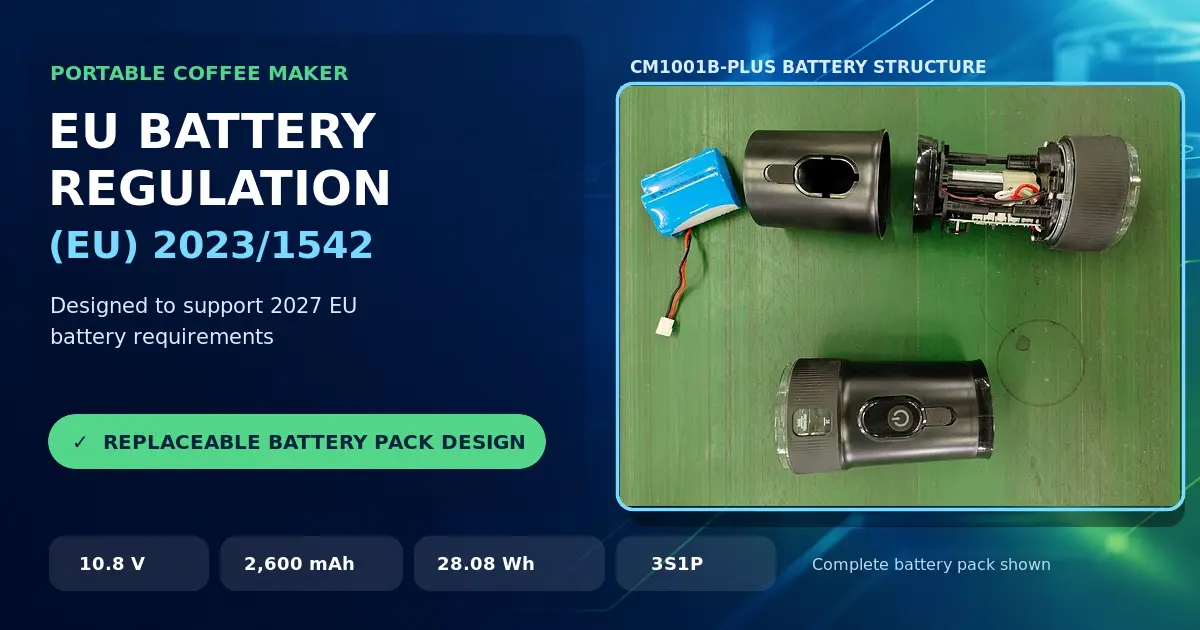
For example, the CM1001B-PLUS uses three 18650 cells in a 3S1P battery pack. The regulation does not mean that the user should separate and replace individual 18650 cells.
The complete battery pack should be removable and replaceable without:
- Damaging the coffee maker;
- Damaging the battery;
- Affecting product safety;
- Using heat or solvents;
- Requiring an unavailable proprietary tool.
The replacement battery must also be compatible with the product. After replacement, the coffee maker should continue to operate safely and maintain its intended performance.
Instructions covering battery use, removal, replacement and safety must be provided with the product and remain available online.
A Serviceable Battery Is Not Always an End-User Replaceable Battery
This is an important difference.
A factory technician may be able to open a coffee maker and change the battery. That does not automatically mean the product meets the end-user replaceability requirement.
The access method, connector, wiring, insulation and replacement procedure must be suitable for an ordinary adult without specialist repair experience.
As an engineer, I would not describe a product as “2027-ready” simply because the housing can be opened. The complete replacement process still needs to be checked for safety, clarity and possible misuse.
CM1001B-PLUS Battery Specifications
The CM1001B-PLUS uses the following battery and heating configuration:
| Item | CM1001B-PLUS specification |
|---|---|
| Battery type | Rechargeable lithium-ion battery pack |
| Cell format | Three 18650 cells |
| Pack configuration | 3S1P |
| Nominal voltage | 10.8 V |
| Rated capacity | 2,600 mAh |
| Battery energy | 28.08 Wh |
| Discharge rate | 5C |
| Charging input | USB-C, 5 V/2 A |
| Heating system | 12 V/100 W thick-film heater |
| Cold-water performance | Approximately 50 ml heated to around 85°C in 4–5 minutes |
| Heated cups per charge | Approximately 3–5 |
| Hot-water extractions | Approximately 300–500 |
Actual performance varies with the starting water temperature, water volume, battery condition and outdoor temperature.
Why Does the 5C Discharge Rate Matter?
Capacity alone does not tell us whether a battery can operate a self-heating coffee maker.
A 100 W heating system running from a 10.8 V battery requires a theoretical current of approximately:
100 W ÷ 10.8 V = 9.26 A
The actual current may be higher because of voltage drop and system losses.
For a 2,600 mAh cell:
- 1C is approximately 2.6 A;
- 3C is approximately 7.8 A;
- 5C is approximately 13 A.
This is why we use a 5C battery configuration in the CM1001B-PLUS. A low-discharge battery may have the same 2,600 mAh capacity printed on its label, but it may struggle with the heating load.
Possible results include slow heating, sudden shutdown, excessive battery temperature and faster capacity loss.
How Is the CM1001B-PLUS Prepared for the 2027 Requirement?
The current CM1001B-PLUS uses a complete battery pack connected through terminals. The cells are not intended to be removed individually.
The pack can be accessed after opening the product housing, which gives us a practical basis for a replaceable-battery design.
However, several items must still be completed before making a final EU 2027 compliance claim:
- Confirm that the battery can be accessed with commercially available tools;
- Validate that removal does not damage the product or battery;
- Prepare clear end-user removal and replacement instructions;
- Add battery handling and safety warnings;
- Define the compatible replacement battery pack;
- Arrange long-term replacement battery availability;
- Complete the required battery labels and QR code;
- Review the technical documentation and EU Declaration of Conformity.
We are treating this as a complete product update, not simply a change to the battery label.
Does the CM1001B-PLUS Need a Battery Passport?
No battery passport is expected for this battery configuration.
The CM1001B-PLUS battery pack has an energy rating of 28.08 Wh, which is far below 2 kWh. It is also not an electric-vehicle or light-means-of-transport battery.
It will still need the applicable battery information and QR code, but the QR code should not be confused with the battery passport required for certain larger battery categories.
What Information Should the QR Code Provide?
From 18 February 2027, batteries must be marked with a QR code.
For portable batteries such as the CM1001B-PLUS battery pack, the QR code is expected to provide access to applicable information including:
- Battery identification;
- Manufacturer or responsible economic operator information;
- Battery chemistry and capacity information;
- EU Declaration of Conformity;
- Applicable label information;
- Waste-battery handling and separate-collection information.
The final QR-code page should be publicly accessible, stable and available for the expected life of the product.
UN38.3, MSDS and IEC 62133-2 Are Still Important
The new regulation does not make existing battery documents unnecessary.
For a battery-powered portable coffee maker, buyers should normally request:
| Document | Main purpose |
|---|---|
| UN38.3 test summary | Lithium battery transport |
| MSDS | Battery handling and safety information |
| IEC 62133-2 report | Rechargeable battery safety |
| Battery specification sheet | Voltage, capacity, energy and discharge data |
| EU Declaration of Conformity | EU regulatory conformity |
| Technical documentation | Product design, risk and conformity evidence |
A UN38.3 report alone does not prove compliance with Regulation (EU) 2023/1542. It mainly confirms that the battery has passed the required transport tests.
What Should EU Buyers Ask Their Supplier?
Before purchasing a battery-powered portable coffee maker, ask the supplier:
- Is the battery installed as a complete replaceable pack?
- What tools are needed to access it?
- Can it be replaced without damaging the housing or wiring?
- Will removal and replacement instructions be supplied?
- How long will replacement packs remain available?
- What are the battery voltage, capacity and Wh rating?
- What is the continuous discharge rating?
- Are UN38.3, MSDS and IEC 62133-2 documents available?
- Who is responsible for the EU battery declaration and QR-code page?
- Who will handle battery producer registration and extended producer responsibility in the target market?
These questions are more useful than simply asking whether the battery has “CE.”
Producer Registration and Waste-Battery Responsibilities
Brands and importers should also check whether they qualify as the battery producer in each EU country where the product is first made available.
Depending on the sales arrangement, responsibilities may include:
- Producer registration;
- Extended producer responsibility;
- Waste-battery collection and treatment;
- Customer information;
- Reporting;
- Appointment of an authorised representative where required.
These obligations should be confirmed before the product is launched, especially when selling directly through online channels in several EU countries.
Frequently Asked Questions
When does the replaceable-battery requirement start?
Article 11 of Regulation (EU) 2023/1542 applies from 18 February 2027.
Must users replace the individual 18650 cells?
No. The requirement applies to the complete battery pack, not to individual cells inside the pack.
Can a supplier claim compliance because a technician can replace the battery?
Not automatically. The general rule requires the portable battery to be removable and replaceable by the end user unless a valid derogation applies.
Does a portable coffee maker need a battery passport?
A 28.08 Wh portable coffee maker battery does not fall into the main battery-passport categories. It will still require the applicable QR-code information.
Is the QR code the same as a battery passport?
No. All batteries are expected to carry a QR code from 18 February 2027, but only certain battery categories require a battery passport.
Does UN38.3 prove compliance with the EU Battery Regulation?
No. UN38.3 covers lithium battery transport testing. Regulation (EU) 2023/1542 includes additional requirements covering conformity, labelling, replaceability, waste management and producer responsibility.
How many cups can the CM1001B-PLUS make per charge?
It normally prepares approximately 3–5 cups when heating cold water. When hot water is added for direct extraction, one charge can support approximately 300–500 extraction cycles.
Planning an EU Portable Coffee Maker Project?
The EU Battery Regulation should be considered before confirming the housing, battery pack, user manual and after-sales plan.
Ningbo Tongxin Technology Co., Ltd. manufactures rechargeable portable coffee makers for importers, distributors and private-label brands.
View the CM1001B-PLUS portable coffee maker or read our portable coffee maker buying guide.
Contact us for samples, battery documents, product specifications or OEM project evaluation.
Company Information
Company: Ningbo Tongxin Technology Co., Ltd.
Main Products: Portable Coffee Makers, Capsule Coffee Machines, and Home Coffee Machines
Services: OEM, ODM, Wholesale, and Private-Label Manufacturing
Address: No. 17 West Street, Industrial Park West Area, Guanhaiwei Town, Cixi, Ningbo, Zhejiang, China
Website: coffeemachinefactory.com
Email: simonxiong@coffeemachinefactory.com
Written by Yong Xiong, engineer at Ningbo Tongxin Technology Co., Ltd., with 20 years of small-appliance development experience and 10 years of coffee-machine development experience.
This article provides general product and regulatory information. It is not legal advice. Final compliance should be confirmed for the product configuration, responsible economic operator and target EU markets.